The traditional enterprise security perimeter is no longer a reliable boundary for protecting applications, users, devices, and data. Cloud services, remote work, SaaS applications, hybrid infrastructure, APIs, and distributed workloads have created an environment in which network location alone is insufficient as a basis for trust.
IBM’s 2026 Cost of a Data Breach Report puts the global average cost of a data breach at approximately $4.99 million. The report also highlights the growing impact of AI-driven attacks and increasingly complex security environments. (IBM)
For enterprise security and procurement teams, the question is no longer whether Zero Trust is relevant. The more practical questions are:
- Which Zero Trust controls should be implemented first?
- Which identity, endpoint, and network platforms fit the existing environment?
- How much will the architecture cost over several years?
- How can an organization modernize access without disrupting critical applications?
This guide answers those questions through a NIST-aligned architecture framework, vendor comparison, TCO model, enterprise decision matrix, implementation scenarios, and deployment checklist.
1. What Is Zero Trust Security?
NIST SP 800-207 describes Zero Trust as an evolving set of cybersecurity principles that moves security away from broad network perimeters and toward protecting individual resources. Users and devices should not receive implicit trust simply because they are located inside a corporate network or connected through a trusted network path. (NIST SP 800-207)
A practical summary is:
Verify explicitly. Use least privilege. Assume breach.
Zero Trust does not mean repeatedly asking users to enter passwords or complete MFA prompts during every activity. Instead, authorization decisions can incorporate identity, device health, resource sensitivity, location, session information, and other available risk signals.
When risk changes materially, a security policy can require stronger authentication, restrict access, or terminate a session.
Core Zero Trust Principles
Eliminate implicit trust
A corporate LAN, VPN connection, or known IP address should not automatically establish authorization to sensitive resources.
Verify explicitly
Authentication and authorization should consider relevant identity and environmental signals instead of relying on network location alone.
Apply least privilege
Users, administrators, applications, and services should receive only the permissions necessary to perform an authorized task.
Assume breach
Architectures should limit the impact of a compromised account, endpoint, credential, application, or workload.
2. NIST-Aligned Zero Trust Architecture Framework
Zero Trust is not a single product. It is an architectural model that combines identity, policy, endpoint, network, application, workload, and security-monitoring controls.
NIST SP 800-207 identifies three important logical components:
Policy Engine (PE)
The Policy Engine evaluates available information and determines whether access to a protected resource should be granted, denied, or revoked.
Policy Administrator (PA)
The Policy Administrator communicates the policy decision to the enforcement infrastructure and establishes or terminates access as appropriate.
Policy Enforcement Point (PEP)
The Policy Enforcement Point enforces the decision at the point where access to a resource is actually controlled.
A simplified enterprise architecture looks like this:
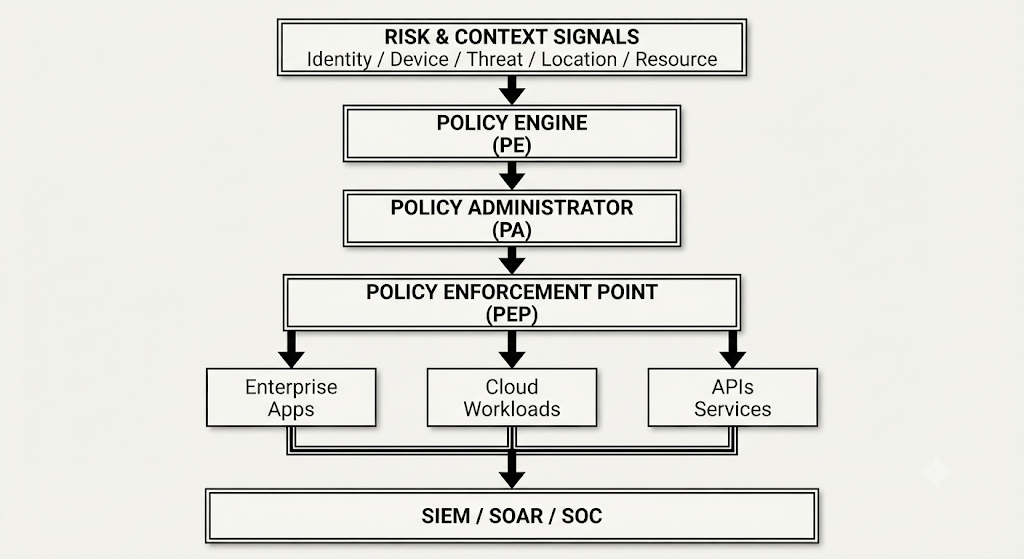
For cloud-native and multi-cloud environments, Zero Trust also needs to consider application and service identities, API gateways, service-to-service communication, and other workload-level controls. NIST SP 800-207A specifically addresses these requirements. (NIST SP 800-207A)
3. Core Components of an Enterprise Zero Trust Stack
A mature Zero Trust environment generally combines several security domains.
Identity and Access Management (IAM)
IAM provides the foundation for authentication, SSO, MFA, authorization, identity lifecycle management, and identity governance.
For many enterprises, IAM is the most logical starting point because other controls depend on reliable identity information.
Zero Trust Network Access (ZTNA) and SASE
ZTNA provides application- or resource-level access instead of automatically placing users on a broad internal network.
This makes ZTNA particularly useful for replacing or reducing traditional VPN-based remote access.
Endpoint Detection and Response (EDR)
EDR monitors endpoint activity and provides detection, investigation, and response capabilities.
Endpoint posture can also become a signal in access decisions. A compromised or non-compliant device may receive more restrictive access than a healthy managed device.
Privileged Access Management (PAM)
PAM controls high-risk administrative identities and can provide credential management, approval workflows, session monitoring, and audit capabilities.
SIEM / SOAR
SIEM platforms centralize security telemetry. SOAR capabilities can automate predefined investigation and response workflows.
The objective is not simply to collect logs but to create a feedback loop in which security signals can influence access and response decisions.
4. Enterprise Zero Trust Software Comparison
There is no universally best Zero Trust platform. Product selection should reflect the organization’s existing identity provider, endpoint environment, cloud infrastructure, application portfolio, compliance requirements, and security operating model.
The following should therefore be considered a representative enterprise shortlist rather than a universal ranking.
| Category | Representative Product | Best Fit | Main Strength | Key Consideration |
|---|---|---|---|---|
| IAM | Microsoft Entra ID | Microsoft-centric environments | Strong integration with Microsoft identity and security services | Advanced capabilities may depend on broader Microsoft licensing |
| IAM | Okta Workforce Identity | Heterogeneous SaaS and application environments | Broad identity integrations | Licensing and integration costs require detailed evaluation |
| ZTNA / SASE | Zscaler Private Access | Large distributed enterprises | Application-level private access | Migration and policy design can be complex |
| ZTNA / SASE | Cloudflare One | Cloud-first and distributed organizations | Globally distributed edge and integrated Zero Trust services | Complex legacy environments may require additional design |
| Endpoint | CrowdStrike Falcon | Organizations prioritizing advanced endpoint detection | Endpoint telemetry and response capabilities | Full-module deployments can increase TCO |
| Endpoint | Microsoft Defender for Endpoint | Microsoft-heavy Windows environments | Strong integration with Microsoft security and device management | Value depends heavily on existing Microsoft licensing |
How These Products Should Be Evaluated
Enterprise buyers should compare vendors across at least six dimensions:
Identity integration — Can the platform work with the existing directory, HR systems, SaaS applications, and authentication standards?
Device and risk signals — Can device health and contextual risk influence access decisions?
Application coverage — Can the solution protect SaaS, private cloud, on-premises, custom, and legacy applications?
Operational complexity — How difficult is deployment, policy management, troubleshooting, and ongoing administration?
Scalability — Can the platform support the organization’s users, devices, workloads, applications, and telemetry volume?
Total cost of ownership — What will the organization spend on licensing, infrastructure, implementation, integration, security operations, and future expansion?
5. Enterprise Zero Trust Decision Matrix: Which Approach Fits Your Organization?
The right architecture often depends more on the existing environment than on the security product itself.
| Organization Profile | Primary Challenge | Recommended Priority | Typical Architecture Direction |
|---|---|---|---|
| Microsoft 365 + Windows-centric | Identity fragmentation and endpoint control | IAM + Device Security | Entra ID + endpoint/device controls |
| SaaS-heavy, multi-vendor | Identity sprawl | IAM + SSO + Lifecycle | Cross-platform IAM and identity governance |
| Global remote workforce | Broad VPN access | ZTNA / SASE | Application-level remote access |
| Legacy-heavy enterprise | Applications without modern identity | Application Access | Identity-aware proxy + gateway + gradual modernization |
| Privileged-access risk | Excessive admin privileges | PAM | Privileged identity controls + session monitoring |
| Small security team | Alert volume and staffing | Platform consolidation + MDR/MSSP | Integrated security platform + managed operations |
| Cloud-native / microservices | Service identity and east-west traffic | Workload Identity | API gateway + service identity + policy enforcement |
A Simple Selection Rule
For many organizations, the most efficient starting point is:
Fix identity first, improve device visibility second, reduce unnecessary network access third, and then extend Zero Trust to applications and workloads.
This prevents an organization from attempting to deploy every Zero Trust technology simultaneously.
6. Enterprise Zero Trust Total Cost of Ownership (TCO)
Zero Trust costs are often underestimated because organizations focus only on software subscriptions.
A realistic TCO model should include five major categories.
Software
- IAM
- MFA
- EDR
- ZTNA/SASE
- PAM
- SIEM/SOAR
Data and Usage
- network traffic
- log ingestion
- data retention
- analytics consumption
Implementation
- architecture design
- identity integration
- application onboarding
- policy development
- migration engineering
- testing
Operations
- security engineering
- security operations
- identity administration
- endpoint administration
- MSSP or MDR services
Business Transition Costs
- employee training
- application remediation
- legacy modernization
- process changes
- temporary coexistence of legacy and modern controls
A practical model is:
3–5 Year Zero Trust TCO
        │
        ├── Licensing
        │     ├── IAM
        │     ├── EDR
        │     ├── ZTNA / SASE
        │     └── PAM
        │
        ├── Usage
        │     ├── Traffic
        │     └── SIEM Data
        │
        ├── Implementation
        │     ├── Integration
        │     ├── Migration
        │     └── Application Onboarding
        │
        ├── Operations
        │     ├── Internal Staff
        │     └── MSSP / MDR
        │
        └── Transition
              ├── Training
              ├── Legacy Remediation
              └── Dual-Run Costs
Because enterprise agreements are frequently customized, published list prices should be treated as an initial reference rather than a complete TCO estimate.
For procurement, the more useful question is:
What will this architecture cost to operate over three to five years?
rather than:
What is the monthly license price?
7. Zero Trust vs. Traditional Perimeter Security
Zero Trust does not make firewalls, VPNs, segmentation, or network security obsolete.
Instead, it changes how trust and authorization decisions are made.
| Feature | Traditional Perimeter-Oriented Model | Zero Trust-Oriented Model |
|---|---|---|
| Trust basis | Network location may be a major trust factor | Identity, device, resource, context, and policy |
| Remote access | Often broad network-level VPN access | Usually resource- or application-level access |
| Segmentation | VLANs, routing, firewall zones | Identity-, application-, and policy-aware controls |
| Device state | Often handled separately | Can directly influence access decisions |
| Access model | Broader network reach may follow authentication | Least-privilege resource access |
| Security assumption | Strong emphasis on defending the perimeter | Assumes compromise can occur and limits blast radius |
A traditional VPN can still have a legitimate role in some network-to-network, infrastructure, and legacy connectivity scenarios.
For remote application access, however, ZTNA can reduce the need to extend broad network access to users. Cloudflare and Zscaler both document ZTNA as an approach for modernizing traditional remote-access architectures. (Cloudflare; Zscaler)
8. Enterprise Zero Trust Implementation Roadmap
Zero Trust should be treated as a progressive transformation rather than a single infrastructure replacement.
Phase 1: Asset Discovery and Visibility
Identify:
- workforce identities
- privileged accounts
- endpoints
- applications
- cloud resources
- service identities
- data flows
- third-party access
- existing VPN and network dependencies
Phase 2: Identity Hardening
Prioritize:
- MFA
- phishing-resistant authentication where appropriate
- SSO
- privileged identity controls
- lifecycle automation
- entitlement reviews
Phase 3: Device and Workload Posture
Define minimum requirements for accessing sensitive resources.
Examples include:
- supported operating systems
- encryption
- endpoint protection
- device management enrollment
- patch status
- security-agent health
Phase 4: Application-Level Access
Gradually replace broad network access with resource-specific policies.
Good early candidates often include:
- administrative interfaces
- sensitive internal applications
- third-party access
- development environments
- remote-access applications
Phase 5: Monitoring and Automated Response
Connect identity, endpoint, network, application, and cloud telemetry to SIEM and security operations workflows.
Phase 6: Cloud-Native Workload Identity
For microservices and multi-cloud systems, extend Zero Trust controls to applications, APIs, workloads, and service identities.
9. Three Real-World Enterprise Zero Trust Implementation Scenarios
The following scenarios illustrate how the architecture can be adapted to different operating environments.
Scenario A: 500-Employee Microsoft-Centric Company
Current environment
- Microsoft 365
- Windows endpoints
- Azure
- Intune
- limited remote workforce
- small security team
Primary risks
The company may have reasonable infrastructure security but weak conditional access, unmanaged devices, excessive privileges, or inconsistent identity policies.
Recommended sequence
Step 1: strengthen Entra-based authentication and MFA
Step 2: establish device compliance policies
Step 3: integrate endpoint security
Step 4: review privileged accounts
Step 5: gradually introduce application-level access for sensitive resources
Main objective
Do not attempt a complete network transformation immediately.
The highest return may come from strengthening the identity and device-control layers first.
Scenario B: 5,000-Employee Global Enterprise
Current environment
- multiple offices
- remote workers
- multiple cloud platforms
- hundreds of SaaS applications
- private enterprise applications
- existing VPN infrastructure
Primary risks
The major challenge is often policy consistency across a large and heterogeneous environment.
Recommended sequence
Step 1: consolidate identity and access policies
Step 2: implement phishing-resistant authentication for high-risk identities
Step 3: integrate endpoint posture with access decisions
Step 4: migrate high-value remote applications to ZTNA
Step 5: integrate security telemetry with SIEM/SOAR
Step 6: address privileged and service identities
Main objective
Reduce broad network access while maintaining business continuity during migration.
A phased coexistence period between VPN and ZTNA is often more practical than an immediate VPN shutdown.
Scenario C: Legacy-Heavy Manufacturing or Infrastructure Enterprise
Current environment
- on-premises applications
- older authentication protocols
- industrial or specialized systems
- limited application modernization
- strict availability requirements
Primary risks
The organization cannot simply replace legacy applications or network controls without potentially disrupting operations.
Recommended sequence
Step 1: inventory critical application dependencies
Step 2: classify applications by sensitivity and modernization capability
Step 3: place legacy applications behind appropriate identity-aware gateways where practical
Step 4: introduce stronger authentication at the access layer
Step 5: segment critical resources
Step 6: modernize applications gradually rather than forcing immediate replacement
Main objective
Reduce implicit trust without creating operational risk.
For this type of organization, Zero Trust is better treated as a migration strategy than as a single product deployment.
10. Zero Trust Pre-Deployment Checklist
Before purchasing or deploying a Zero Trust platform, security and procurement teams should be able to answer the following questions.
Identity
- Do we have a reliable inventory of workforce identities?
- Are privileged accounts separated and monitored?
- Is MFA enforced for high-risk access?
- Are joiner/mover/leaver processes automated?
Devices
- Do we know which devices access corporate resources?
- Can we identify unmanaged or non-compliant endpoints?
- Is device health available as an access signal?
Applications
- Which applications are business-critical?
- Which applications support SAML, OIDC, OAuth, or other modern identity mechanisms?
- Which applications are legacy?
- Which applications require broad network connectivity?
Network
- Where is VPN currently required?
- Which applications can move to ZTNA?
- Where does network-to-network connectivity remain necessary?
- Are critical systems segmented?
Security Operations
- Are identity, endpoint, network, and cloud logs centralized?
- Which security events should trigger automated actions?
- Who monitors alerts outside business hours?
- Will the organization rely on internal SOC, MDR, or MSSP services?
Financial
- What is the three-year and five-year TCO?
- Does the proposed license require additional modules?
- Are implementation services included?
- What happens when the number of users or devices doubles?
- What data-ingestion costs could grow unexpectedly?
Governance
- Which regulations apply?
- Who owns Zero Trust policy?
- Who approves access exceptions?
- How frequently will policies be reviewed?
11. How to Choose the Right Zero Trust Architecture
A practical decision process can be summarized in five questions:
Question 1: Where is the greatest current risk?
If the biggest problem is compromised accounts, start with IAM.
If the biggest problem is unmanaged endpoints, prioritize device security.
If the biggest problem is remote network access, prioritize ZTNA.
If privileged accounts are the primary concern, prioritize PAM.
Question 2: What technology environment already exists?
An organization deeply invested in Microsoft may achieve better operational efficiency from an integrated Microsoft architecture.
A heterogeneous environment may place more value on broad identity and application integrations.
Question 3: How much legacy technology must remain?
The more legacy applications an organization operates, the more important transition controls such as gateways, proxies, segmentation, and phased migration become.
Question 4: Who will operate the platform?
An advanced product with insufficient internal staffing may create more operational risk than a simpler platform with strong managed-service support.
Question 5: What does success look like?
Zero Trust should be measured using outcomes such as:
- reduced broad network access
- improved MFA coverage
- fewer standing privileged credentials
- increased device compliance
- reduced attack surface
- faster incident response
- lower dependency on legacy remote-access models
A Zero Trust project should not be considered successful simply because a new security product has been installed.
12. Zero Trust Security FAQ
Can Zero Trust completely replace a traditional VPN?
Not in every scenario. ZTNA can replace traditional VPN-based access for many remote application-access use cases by granting users access to specific resources rather than broad network connectivity. However, network-to-network connectivity, specialized legacy systems, and infrastructure scenarios may continue to require VPN or other connectivity technologies.
What is the difference between IAM and Zero Trust?
IAM manages identity, authentication, authorization, and access lifecycle. Zero Trust is broader and uses identity together with device posture, resource sensitivity, network controls, application controls, and other context to make access decisions.
Does Zero Trust require continuous re-authentication?
No. Continuous verification does not necessarily mean repeated MFA prompts. Security systems can continually evaluate available signals and trigger additional authentication, restrictions, or session termination when risk changes.
Is Microsoft Entra ID a complete Zero Trust platform?
No single product represents the entire Zero Trust architecture. Entra provides important identity and access capabilities, but enterprises typically need complementary controls for endpoints, applications, networks, workloads, data, and security operations.
How does Zero Trust handle legacy applications?
Legacy applications that cannot directly support modern identity protocols can sometimes be placed behind identity-aware proxies, gateways, or other policy enforcement layers. This allows stronger authentication and access control while the underlying application is gradually modernized.
Is Zero Trust the same as SASE?
No. Zero Trust is an architectural approach and security strategy. SASE is a broader architecture combining networking and security capabilities through a cloud-oriented delivery model. ZTNA may be one component of a SASE implementation.
How much does enterprise Zero Trust cost?
There is no universal price. Cost depends on users, devices, applications, traffic, data ingestion, security modules, implementation effort, and operating model. Procurement teams should compare multi-year TCO rather than software subscription price alone.
Conclusion
Zero Trust is not a single security product and it does not require every organization to immediately eliminate firewalls, VPNs, or existing network controls.
Its fundamental objective is to reduce unnecessary implicit trust and move access decisions toward identity, device, resource, context, and least privilege.
For most enterprises, the practical path is incremental:
strengthen identity → validate devices → reduce broad network access → secure privileged identities → integrate security telemetry → extend controls to applications and workloads.
The right solution depends on the organization’s environment.
A Microsoft-centric organization may prioritize an integrated identity and endpoint architecture. A heterogeneous enterprise may place greater emphasis on cross-platform IAM. A globally distributed company may prioritize ZTNA and SASE. A legacy-heavy environment may need identity-aware gateways and a gradual modernization plan.
The best Zero Trust architecture is therefore not necessarily the one with the most features.
It is the architecture that reduces meaningful risk, integrates with the systems already in place, remains operationally manageable, and delivers acceptable three- to five-year TCO.
Quick Executive Decision Framework
IDENTIFY THE PRIMARY RISK
            │
            ▼
    ┌─────────────────┐
    │ Identity Risk?  │──► IAM / MFA
    └─────────────────┘
            │
            ▼
    ┌─────────────────┐
    │ Device Risk?   │──► EDR / Device Posture
    └─────────────────┘
            │
            ▼
    ┌─────────────────┐
    │ VPN / Network?  │──► ZTNA / SASE
    └─────────────────┘
            │
            ▼
    ┌─────────────────┐
    │ Admin Risk?     │──► PAM
    └─────────────────┘
            │
            ▼
    ┌─────────────────┐
    │ Cloud / APIs?   │──► Workload & API Security
    └─────────────────┘
            │
            ▼
       SIEM / SOAR
            │
            ▼
    CONTINUOUS POLICY
       IMPROVEMENT
Sources
- NIST SP 800-207, Zero Trust Architecture
- NIST SP 800-207A, A Zero Trust Architecture Model for Access Control in Cloud-Native Applications in Multi-Cloud Environments
- IBM, Cost of a Data Breach Report 2026
- Microsoft, Zero Trust and Microsoft Entra documentation
- Okta, Workforce Identity documentation
- Cloudflare, Cloudflare One / Zero Trust documentation
- Zscaler, Zscaler Private Access documentation
[Disclaimer]
This article is provided for educational and informational purposes only and does not constitute professional cybersecurity, legal, compliance, or financial advice. Enterprise security architectures should be evaluated against each organization’s specific threat model, regulatory requirements, technology environment, and risk tolerance. Product capabilities, licensing terms, and pricing can change over time. Always verify current product documentation and commercial terms directly with the vendor before making a purchasing or architecture decision.