Generative AI is moving beyond the chatbot interface.
For the first wave of enterprise adoption, AI was primarily used to generate text, summarize documents, answer questions, and assist employees. The human remained responsible for deciding what happened next.
In 2026, the more important shift is not simply that AI models are becoming more capable. It is that organizations are connecting models to tools, business systems, code execution environments, APIs, enterprise data, and long-running workflows.
That changes the architectural problem.
A chatbot produces an answer.
An AI agent can decide what action to take, invoke a tool, inspect the result, update its state, and continue working toward a defined objective.
A multi-agent system goes one step further by allowing specialized agents or workflows to divide responsibilities, execute tasks in parallel, or hand work to another agent.
But autonomy should not be treated as an end in itself.
The most reliable enterprise systems are not necessarily the most autonomous. In many cases, a deterministic workflow with one carefully bounded agent performs better operationally than a large multi-agent system.
The real enterprise opportunity in 2026 is therefore:
Turning AI capability into controlled, measurable, executable business workflows.
This guide explains how to design that architecture, decide when to use a single agent or multiple agents, choose an orchestration framework, control permissions and security risks, measure ROI, and move from prototype to production.
1. From Chatbots to Agentic Workflows
A conventional chatbot follows a relatively simple pattern:
User
  ↓
Prompt
  ↓
LLM
  ↓
Response
  ↓
Human decides what happens next
An agentic application introduces external actions and feedback:
Business Goal
      ↓
Agent
      ↓
Plan / Decide
      ↓
Tool or System
      ↓
Observe Result
      ↓
Evaluate
      ↓
Continue / Retry / Escalate
      ↓
Business Outcome
The important distinction is therefore not that an agent “thinks harder.”
It is that the system can participate in an executable process.
For example, an IT operations agent may:
- Receive an incident.
- Retrieve monitoring data.
- Inspect recent deployment activity.
- Query logs.
- Form a diagnosis.
- Propose a remediation action.
- Execute an approved low-risk operation.
- Verify the outcome.
- Escalate to a human if the action exceeds its authority.
That is fundamentally different from asking an AI assistant to summarize an incident report.
2. What Is an AI Agent?
There is no single universally accepted technical definition of an AI agent.
In practical enterprise architecture, an agent can be understood as a software system that combines an AI model with some combination of:
- instructions
- tools
- external data
- state
- memory
- decision logic
- execution capabilities
- policy controls
- evaluation and observability
The model provides probabilistic reasoning, but the surrounding software determines what the system is actually allowed to do.
A useful architecture is:
Agent
 │
 ├── Model
 ├── Instructions
 ├── Context
 ├── State
 ├── Tools
 ├── Policies
 ├── Execution Environment
 └── Evaluation / Observability
This distinction matters because the model is not the agentic system.
An enterprise application can use the same underlying model while behaving very differently depending on its tools, permissions, context, workflow logic, and execution environment.
3. Chatbot vs Workflow vs Agent vs Multi-Agent
One of the most important design decisions is choosing the correct level of autonomy.
| Architecture | Decision Maker | Autonomy | Best Fit |
|---|---|---|---|
| Chatbot | Human | Low | Q&A, drafting, summarization |
| Deterministic Workflow | Application logic | Low | Stable business processes |
| Workflow + Agent Step | Developer + Agent | Low–Medium | Structured processes with reasoning steps |
| Single Agent | Agent | Medium | Dynamic tool use and bounded tasks |
| Long-Running Agent | Agent + Runtime | Medium–High | Complex work spanning many steps or sessions |
| Multi-Agent System | Multiple agents + Orchestrator | High complexity | Parallel, specialized, or distributed tasks |
The critical lesson is:
More agents do not automatically produce a better system.
Anthropic’s engineering guidance emphasizes simple, composable patterns and notes that multi-agent systems introduce additional coordination and evaluation complexity.
Microsoft’s current Agent Framework similarly treats workflows and agents as different points on a spectrum: developers can choose deterministic workflow paths when the application should control what happens next, and agentic delegation when the model should make that decision.
4. When Should You Use a Single Agent or Multi-Agent System?
Use a deterministic workflow when:
- the sequence is known
- the business rules are explicit
- reproducibility is important
- compliance requires predictable execution
Use a single agent when:
- tool selection is dynamic
- the task has moderate complexity
- the problem fits within one domain
- one agent can reasonably manage the required context
Use multiple agents when:
- specialist expertise materially improves the outcome
- tasks can run independently in parallel
- separate agents need different tools or contexts
- the system benefits from explicit responsibility boundaries
- a single agent becomes difficult to manage because of context or tool overload
A practical decision rule is:
Use the simplest architecture that reliably completes the business process.
Multi-agent orchestration should solve a real problem—such as specialization, parallelization, context isolation, or organizational separation—not merely add architectural complexity.
5. Enterprise Agent Architecture
A production agent should not be implemented as an LLM with unrestricted API credentials.
A stronger architecture separates reasoning, control, execution, and observation.
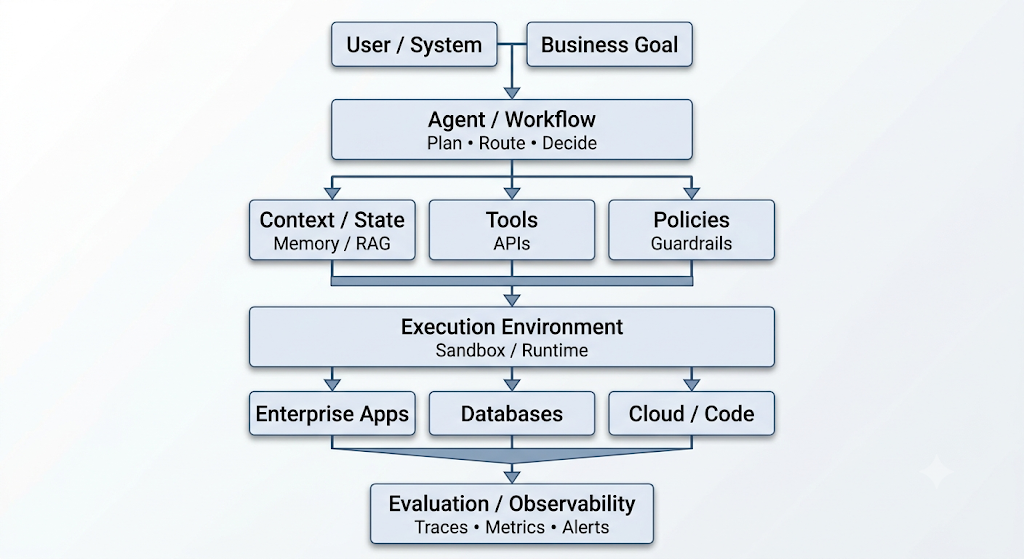
The most important architectural principle is separation of the brain from the hands.
The reasoning model should not automatically receive the broadest possible operational permissions.
OpenAI’s current Agents SDK, for example, supports controlled sandbox execution for long-horizon tasks such as file inspection, command execution, and code modification.
Anthropic’s 2026 engineering work similarly emphasizes the need to contain agent blast radius as agent capabilities and permissions expand.
6. Planning, Tools, State, and Context
Four components become especially important as agents move beyond short interactions.
Planning
Planning determines what actions are necessary to achieve an objective.
In production systems, planning does not always need to appear as a long natural-language plan. It can also be implemented through structured task graphs, state transitions, or workflow nodes.
Tools
Tools connect agents to external systems.
Examples include:
- REST APIs
- SQL databases
- Git repositories
- cloud APIs
- file systems
- browsers
- ticketing systems
- command-line tools
- internal enterprise services
Tool quality matters enormously.
Anthropic’s engineering guidance notes that tools should be designed specifically for agents, with clear boundaries, useful responses, appropriate namespacing, and token-efficient outputs.
State
State records what has happened during workflow execution.
An agent may need to remember:
- completed tasks
- failures
- pending operations
- approvals
- intermediate results
- current workflow position
Modern enterprise workflow frameworks increasingly provide durable state, checkpointing, and resume capabilities. Microsoft Agent Framework, for example, supports checkpointing and resuming long-running workflow execution.
Context Engineering
Context is broader than the system prompt.
It can include:
- conversation history
- retrieved documents
- tool descriptions
- task state
- previous tool results
- policies
- memory
- environmental signals
Anthropic describes this discipline as context engineering: systematically controlling what information reaches the model at each step rather than relying only on prompt wording.
As agents become longer-running, context management can become as important as model selection.
7. Long-Running Agents and Durable Execution
A short agent interaction may complete within seconds.
A production agent may need to work for minutes, hours, or even across multiple execution sessions.
That creates new requirements:
- durable state
- checkpoints
- resumability
- task ownership
- timeouts
- recovery
- idempotency
- progress tracking
- human interruption
Anthropic has highlighted the difficulty of preserving progress across context windows for long-running agents.
Microsoft’s current workflow capabilities similarly provide checkpointing and resuming for workflows and human-in-the-loop interactions.
A robust long-running execution model looks like:
Task
 ↓
Checkpoint
 ↓
Execute
 ↓
Observe
 ↓
Checkpoint
 ↓
Continue
 ↓
Failure?
 ├── No → Continue
 └── Yes → Recover / Retry / Escalate
This turns an agent from a conversational process into a more durable software execution system.
8. Multi-Agent Architecture Patterns
Multi-agent systems are useful when specialization or parallelization provides measurable value.
Supervisor / Orchestrator
A manager agent delegates to specialized workers.
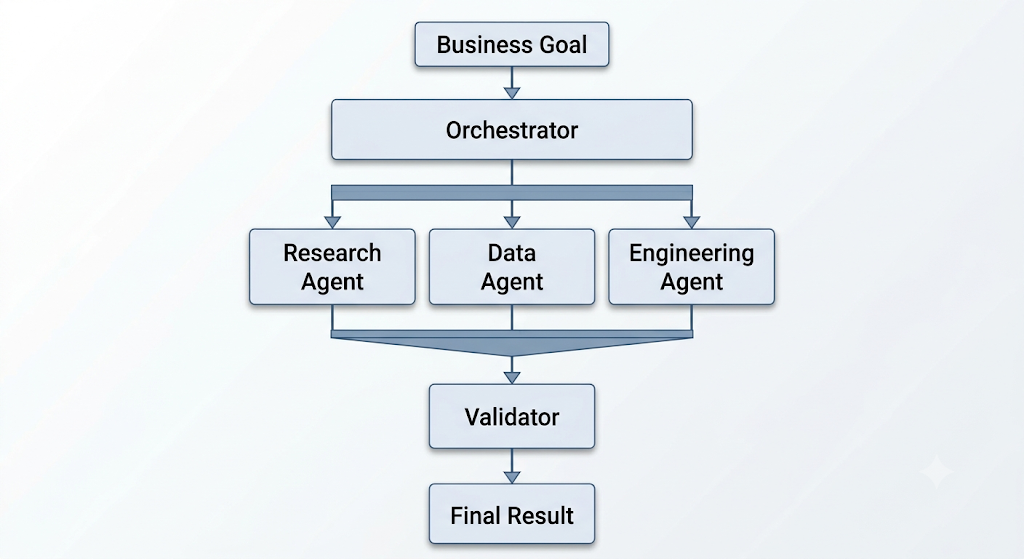
This pattern is useful when one component needs a consistent global view of the task.
Sequential
Agents execute in a defined order.
Agent A → Agent B → Agent CUseful for pipelines with clear dependencies.
Concurrent
Independent agents operate simultaneously.
               ┌──► Agent A
Request ───────┼──► Agent B
               └──► Agent C
                    ↓
                  Merge
Useful for research, classification, or independent analysis.
Microsoft Agent Framework currently provides sequential, concurrent, handoff, group-chat, and Magentic orchestration patterns.
Handoff
One agent transfers responsibility to another based on context.
This can be useful for customer-service or specialist workflows where different domains own different parts of the process.
Hierarchical
A manager delegates to sub-managers, which coordinate worker agents.
This can be powerful for large workflows but increases coordination complexity.
9. MCP, A2A, and Agent Interoperability
Two important interoperability layers are emerging.
Model Context Protocol (MCP)
MCP standardizes how AI applications interact with external context and tools.
The current MCP specification defines a protocol for exposing resources, prompts, and tools between hosts, clients, and servers.
A simplified model is:
Agent
  │
  ▼
MCP Client
  │
  ├──► Database
  ├──► Files
  ├──► APIs
  └──► Enterprise Tools
This can reduce the need to build a custom integration for every agent-tool relationship.
However, MCP is not a substitute for authorization. A connected tool still needs explicit permissions, input validation, isolation, and appropriate trust boundaries.
Agent2Agent (A2A)
A2A is designed for communication and task delegation between agents built by different systems or vendors.
Google introduced A2A as an interoperability protocol for agent-to-agent collaboration across enterprise platforms.
The conceptual distinction is:
Agent
 │
 ├── MCP ──► Tools / Data / Services
 │
 └── A2A ──► Other Agents
This distinction becomes increasingly important as enterprises begin combining agents from multiple platforms.
10. AI Agent Framework Comparison for 2026
Framework selection should be based on how much control the engineering team needs over workflow execution, state, hosting, and vendor integration.
| Framework / Platform | Strongest Area | Best Fit | Main Trade-Off |
|---|---|---|---|
| OpenAI Agents SDK | Agents, tools, handoffs, tracing, controlled sandbox execution | Teams building agentic applications around OpenAI models | Strong integration with OpenAI ecosystem |
| Microsoft Agent Framework | Workflows, state, middleware, orchestration, HITL | Enterprise teams using Python/.NET and Microsoft infrastructure | Rapidly evolving platform |
| LangGraph | Stateful graph orchestration and execution control | Teams wanting fine-grained orchestration | More engineering responsibility |
| Anthropic agent stack | Tool use, context engineering, long-running agent patterns | Teams building around Claude | Strongly influenced by Claude ecosystem |
OpenAI’s current Agents SDK supports long-running tasks, tool use, sandbox execution, and agent orchestration capabilities.
Microsoft Agent Framework currently supports agent workflows, graph-based execution, state, middleware, observability, checkpointing, human-in-the-loop, and multiple multi-agent orchestration patterns.
LangGraph provides stateful graph-based orchestration suitable for sequential, branching, looping, and parallel execution. Its documentation explicitly distinguishes workflow-driven execution from more dynamic agent behavior.
Anthropic’s engineering work emphasizes context engineering, effective tools, long-running agent harnesses, and evaluation rather than treating increasingly complex orchestration as an automatic improvement.
11. Enterprise AI Agent Use Cases
The strongest use cases combine meaningful reasoning with access to structured enterprise systems.
Software Engineering
An engineering agent can:
- inspect a repository
- identify relevant files
- modify code
- execute tests
- diagnose failures
- iterate on the implementation
- prepare a pull request
The execution environment should remain isolated from production infrastructure unless explicitly authorized.
SecOps
A security workflow might:
SIEM Alert
    ↓
Diagnostic Agent
    ↓
Read-only log and endpoint queries
    ↓
Risk Assessment
    ↓
Remediation Proposal
    ↓
Human Approval if High Risk
    ↓
Containment
    ↓
Verification
IT Operations
Agents can investigate tickets, gather monitoring information, compare recent changes, and execute predefined recovery workflows.
Customer Operations
An agent can classify requests, retrieve customer context, update a CRM, draft a response, and escalate exceptions.
Research
Parallel agents can investigate different dimensions of a question and provide findings to a synthesis agent.
Anthropic has described a production research architecture based on a lead agent coordinating specialized subagents in parallel.
Finance and Procurement
Agents can reconcile documents, identify anomalies, prepare purchasing recommendations, and initiate controlled approval workflows.
Supply Chain
Agents can monitor inventory, supplier signals, logistics information, and sales activity to generate recommendations or execute predefined low-risk actions.
The important distinction is that the agent should not automatically receive authority to perform every action it can recommend.
12. Agent Security: A New Software Security Boundary
Once an AI system can act, the security problem changes.
NIST’s Center for AI Standards and Innovation has explicitly identified agent systems as introducing security challenges created by combining model outputs with software capabilities and real-world actions.
Key risks include:
Excessive permissions
A compromised or misbehaving agent with production credentials can cause substantially more damage than a read-only assistant.
Prompt injection
Untrusted documents, web pages, emails, tickets, or tool responses may contain instructions that attempt to manipulate the agent.
Tool abuse
A tool that appears harmless in isolation can become dangerous when chained with another capability.
Data exfiltration
An agent with access to confidential data may be able to transfer it through another tool or system.
Cross-agent trust
In a multi-agent architecture, the output of one agent can become an instruction or data source for another.
Credential leakage
Passing user credentials or long-lived service keys directly into model context expands the attack surface.
State poisoning
Persistent memory or workflow state can become a hidden source of malicious or incorrect instructions.
Excessive autonomy
The broader the action space, the greater the potential blast radius.
Anthropic’s 2026 containment work frames this as a direct engineering problem: as agent capability and access increase, organizations need stronger mechanisms to cap blast radius.
13. Agent Identity and Permission Architecture
Production agents should have explicit identities and controlled permissions.
A practical model is:
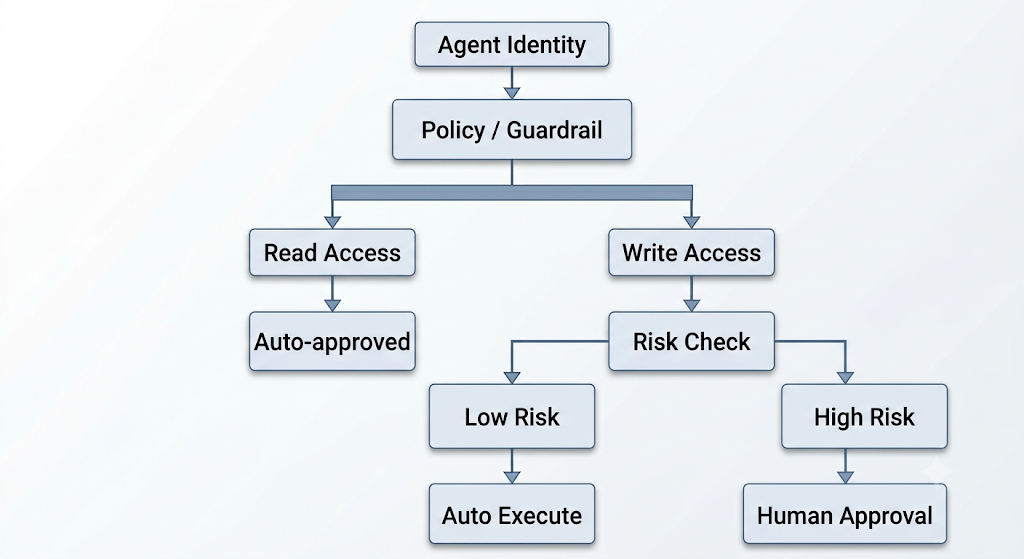
Useful controls include:
- least-privilege credentials
- per-tool permissions
- short-lived credentials
- scoped tokens
- network egress controls
- sandboxed execution
- read/write separation
- approval gates
- action-specific policies
- rate limits
- spending limits
- execution-step limits
The core principle is:
An agent should receive the minimum authority required to complete the task.
14. Human-in-the-Loop and Risk-Based Autonomy
Human oversight does not have to mean manually approving every step.
A better model is risk-based autonomy.
| Risk Level | Example | Recommended Control |
|---|---|---|
| Low | Read document, retrieve metrics | Automatic |
| Medium | Create ticket, draft change | Policy-controlled |
| High | Modify production configuration | Human approval |
| Critical | Delete database, move funds | Mandatory approval |
This makes the system faster without removing meaningful control.
Modern enterprise workflow systems increasingly support explicit human-in-the-loop gates. Microsoft Agent Framework, for example, can pause workflow execution for approval-required tool calls and resume from a checkpoint after the response is provided.
15. Deterministic Controls Around Probabilistic Models
LLMs are probabilistic.
Enterprise systems often require predictable boundaries.
The solution is to surround model reasoning with deterministic validation:
LLM Reasoning
      ↓
Structured Output
      ↓
Schema Validation
      ↓
Business Rules
      ↓
Permission Check
      ↓
Execution
      ↓
Result Validation
      ↓
State Update
Examples include:
- JSON schema validation
- typed tool interfaces
- business-rule engines
- unit tests
- policy engines
- approval workflows
- post-execution verification
This approach does not attempt to make the model deterministic. It makes the system around the model deterministic where it matters.
16. Reliability: Loops, Retries, and Side Effects
Agent systems can fail in ways traditional applications do not.
A poorly designed agent might repeatedly call a failed tool:
Tool Call
   ↓
Failure
   ↓
Retry
   ↓
Failure
   ↓
Retry
   ↓
Cost and latency increase
Production systems should therefore include:
- maximum execution steps
- retry budgets
- exponential backoff
- timeouts
- circuit breakers
- checkpoints
- fallback states
- dead-letter handling
- idempotency
- compensation workflows
Why idempotency matters
Consider an agent authorized to create a purchase order.
If a request times out after the external system has already created the order, blindly retrying may create a duplicate order.
Agentic systems therefore need the same reliability techniques used by distributed software systems, but with additional safeguards because the sequence of actions may be selected dynamically.
17. Evaluation and Observability
A production agent cannot be evaluated only by asking whether its response “looks good.”
Evaluation should cover the entire workflow.
Quality
- task completion rate
- factual accuracy
- tool selection
- policy adherence
Reliability
- failure rate
- retry rate
- timeout rate
- escalation rate
Efficiency
- latency
- tool calls per task
- tokens per task
- compute cost
Safety
- unauthorized actions
- policy violations
- data leakage
- excessive privilege usage
Business Outcomes
- labor hours saved
- ticket resolution time
- error reduction
- revenue impact
- operational cost reduction
Anthropic’s January 2026 guidance emphasizes that agent evaluation is harder than evaluating ordinary LLM responses because agents operate over multiple turns, call tools, modify state, and adapt to intermediate results.
The practical lesson is:
Evaluate the task outcome, not just the generated text.
Observability should also capture the execution path:
Trace
 │
 ├── Agent Decision
 ├── Tool Call
 ├── Tool Result
 ├── Validation
 ├── Approval
 ├── Execution
 └── Final Outcome
This becomes essential when debugging long-running or multi-agent workflows.
18. Agent Economics and TCO
Agentic systems can have very different economics from conventional chatbot applications.
A single business task might trigger:
1 user request
   ↓
1 planning call
   ↓
5 tool calls
   ↓
2 retries
   ↓
3 validation calls
   ↓
1 synthesis call
The actual cost can therefore include:
- model inference
- input and output tokens
- tool execution
- browser/computer-use operations
- database queries
- sandbox compute
- storage
- observability
- human review
- external APIs
A more useful metric is:
Cost per successfully completed business task
rather than simply:
Cost per million tokens
Practical Agent TCO Model
Total Agent Cost
        │
        ├── Model
        │     ├── Inference
        │     └── Context / Tokens
        │
        ├── Tools
        │     ├── APIs
        │     ├── Databases
        │     └── External Services
        │
        ├── Runtime
        │     ├── Sandbox
        │     ├── Compute
        │     └── Storage
        │
        ├── Platform
        │     ├── Orchestration
        │     ├── Observability
        │     └── Evaluation
        │
        └── Human Operations
              ├── Review
              ├── Exception Handling
              └── Engineering
19. Measuring Enterprise ROI
Enterprise adoption should be justified using measurable business outcomes.
A practical ROI framework is:
Annual Agent Benefit
=
Labor Hours Saved
+ Error Reduction
+ Faster Resolution
+ Revenue / Capacity Gain
- Agent Operating Cost
- Integration Cost
- Human Review Cost
Useful KPIs include:
Automation Rate
Percentage of eligible tasks completed without human intervention.
Successful Completion Rate
Percentage of tasks completed correctly.
Human Escalation Rate
How frequently the agent needs intervention.
Cost per Successful Task
Total system cost divided by successfully completed tasks.
Time to Resolution
Elapsed time from task creation to successful completion.
Exception Rate
Percentage of tasks requiring fallback workflows.
These metrics are more useful to executives than raw token counts.
20. Enterprise Deployment Roadmap
Do not begin by deploying a network of autonomous agents.
Start with a bounded business problem.
Phase 1: Select a Business Process
Choose a workflow with:
- clear inputs
- measurable outcomes
- limited initial permissions
- recoverable failures
Phase 2: Build a Deterministic Baseline
Document how the workflow works today.
This gives the team a baseline for measuring whether agentic automation actually improves the process.
Phase 3: Introduce One Agent
Use an agent only where dynamic reasoning adds value.
Do not add autonomy to steps that ordinary application code handles reliably.
Phase 4: Add Tools and Controlled Execution
Expose only the required capabilities.
Implement:
- typed tool interfaces
- scoped permissions
- validation
- audit logging
- sandboxing
Phase 5: Add Evaluation and Observability
Measure:
- success
- failure
- cost
- latency
- safety
- escalation
Phase 6: Add More Agents Only When Justified
Introduce multi-agent orchestration when specialization, parallelization, or context separation produces measurable benefits.
Phase 7: Gradually Increase Autonomy
Read
 ↓
Recommend
 ↓
Draft
 ↓
Execute Low-Risk Actions
 ↓
Execute Within Guardrails
 ↓
Human Approval for High-Risk Actions
This creates a controlled path from experimentation to production.
21. Three Enterprise Implementation Scenarios
Scenario A: 500-Employee Microsoft-Centric Organization
Environment
- Microsoft 365
- Windows endpoints
- Azure
- SaaS applications
- small security/IT team
Priority
The biggest opportunity may be automating repetitive internal workflows rather than building a complex multi-agent system.
Example
Employee Request
       ↓
Single IT Agent
       ↓
Search Knowledge Base
       ↓
Check User / Device Data
       ↓
Create / Update Ticket
       ↓
Resolve or Escalate
A single agent plus tools may be sufficient.
Multi-agent orchestration would add complexity without necessarily providing enough value.
Scenario B: 5,000-Employee Global Enterprise
Environment
- multiple cloud platforms
- hundreds of SaaS applications
- distributed employees
- private applications
- established security operations
Priority
The main challenge is orchestration across multiple domains.
Example
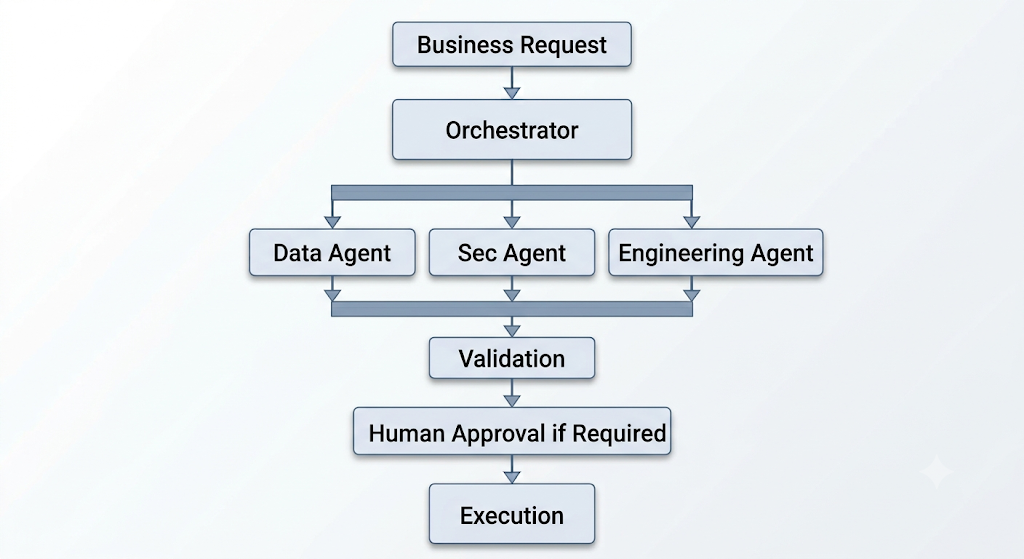
Multi-agent architecture can become valuable when the domains genuinely require different tools, contexts, or expertise.
Scenario C: Legacy-Heavy Enterprise
Environment
- older applications
- on-premises systems
- specialized operational software
- limited API coverage
Priority
Integration is the constraint, not model intelligence.
The architecture may need:
Agent
 ↓
Gateway / Adapter
 ↓
Legacy Application
Instead of forcing every legacy system to become agent-native immediately, organizations can create controlled adapters around existing systems.
This also reduces the blast radius of legacy integrations.
22. Pre-Deployment AI Agent Checklist
Before granting an agent access to real enterprise systems, verify the following.
Business
- What exact task is being automated?
- What defines successful completion?
- What is the baseline human cost?
Architecture
- Is a deterministic workflow sufficient?
- Is one agent sufficient?
- Is multi-agent orchestration actually necessary?
Identity
- Does every agent have a distinct identity?
- Are credentials scoped and short-lived where possible?
- Can agent-to-agent delegation be authenticated and authorized?
Tools
- Are tools narrowly scoped?
- Are inputs validated?
- Can tools perform destructive operations?
- Are read and write operations separated?
Data
- What data can the agent access?
- Can it move data between systems?
- Are sensitive datasets isolated?
Execution
- Is code execution sandboxed?
- Are network destinations restricted?
- Are maximum steps and retries defined?
- Are idempotency and recovery mechanisms implemented?
Human Oversight
- Which actions require approval?
- Who can approve them?
- Can the workflow pause and resume safely?
Observability
- Are all tool calls traced?
- Can the workflow be replayed or investigated?
- Are cost and latency measured?
Governance
- Who owns the agent?
- Who approves permission changes?
- How can the agent be disabled?
- How frequently are evaluations rerun?
23. The 2026 Enterprise Decision Framework
The most important question is not:
Which agent framework should we use?
It is:
Where does autonomy create measurable business value without creating unacceptable operational or security risk?
A practical decision tree is:
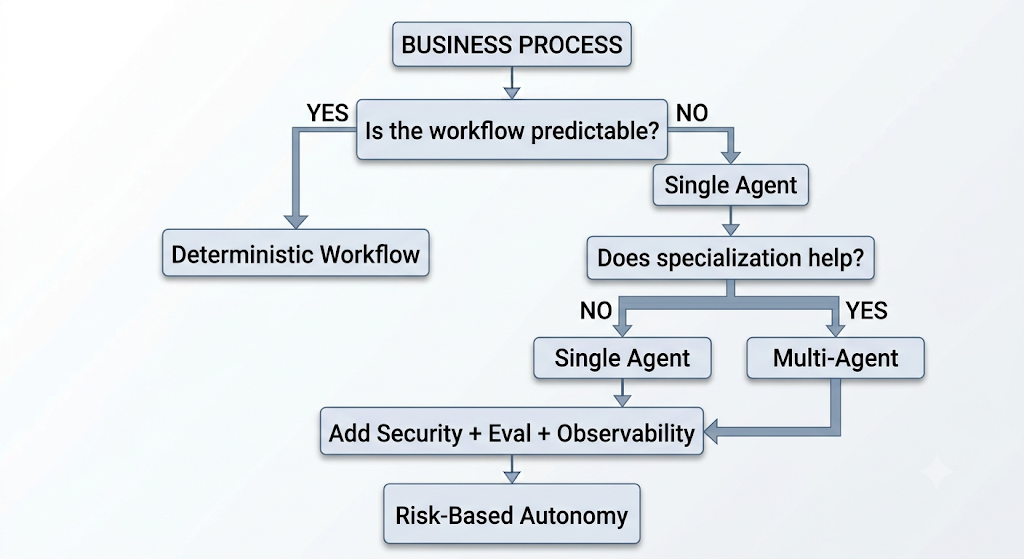
This prevents a common enterprise mistake:
Deploying a multi-agent architecture before proving that agentic automation itself creates business value.
24. What Is Actually Changing in 2026?
Several architectural trends are converging.
1. Agents are becoming execution systems
Modern agent SDKs increasingly support tools, file operations, code execution, long-running tasks, and controlled runtime environments. OpenAI’s April 2026 Agents SDK update is a clear example of this shift.
2. Workflows are becoming a first-class abstraction
Enterprise frameworks increasingly treat workflows, checkpoints, state, observability, and human approval as fundamental components rather than add-ons. Microsoft Agent Framework’s current documentation reflects this directly.
3. Context engineering is becoming as important as prompt engineering
Long-running agents need deliberate management of context, memory, tool descriptions, intermediate results, and workflow state.
4. Tool and agent interoperability is developing
MCP standardizes model-to-tool/context integration, while A2A provides a framework for agent-to-agent collaboration across systems.
5. Agent security is becoming a distinct engineering discipline
NIST is now explicitly examining the security implications of AI agent systems, particularly the risks created when model outputs can trigger real-world software actions.
6. Evaluation is moving from responses to outcomes
As agents gain tools, state, and autonomy, evaluation must measure whether the entire task was completed correctly, safely, efficiently, and consistently.
Conclusion: The Enterprise Agent Is a Controlled Software System
The most important shift in enterprise AI is not simply the emergence of “autonomous agents.”
It is the transformation of AI from a system that generates information into a system that can participate in executable business processes.
That transformation creates significant opportunities in:
- software engineering
- IT operations
- cybersecurity
- research
- customer operations
- finance
- procurement
- supply chain management
But autonomy without architecture creates unacceptable risk.
Production-grade agents require:
identity → scoped permissions → controlled tools → state → deterministic validation → observability → evaluation → human escalation.
And multi-agent systems should not be adopted simply because they are technologically impressive.
The better strategy is:
Start with the smallest architecture that can reliably solve the business problem.
Then increase autonomy only when reliability, security, observability, and economics justify it.
The enterprise AI architecture of 2026 is therefore not a giant swarm of autonomous agents.
It is a controlled execution layer connecting models to real business systems.
The organizations that succeed will be those that can turn that execution layer into measurable business outcomes while keeping its permissions, costs, and failure modes under control.
Sources
- NIST, Security Considerations for AI Agent Systems and CAISI RFI
- OpenAI, The Next Evolution of the Agents SDK
- Microsoft Learn, Agent Framework
- Anthropic, Building Effective Agents
- Anthropic, How We Built Our Multi-Agent Research System
- Anthropic, Effective Context Engineering for AI Agents
- Anthropic, Demystifying Evals for AI Agents
- Model Context Protocol Specification
- Google, Agent2Agent Protocol
- LangGraph Documentation
[Disclaimer]
This article is provided for educational and informational purposes only and does not constitute professional AI engineering, cybersecurity, architectural, legal, financial, or business advice. AI agent capabilities, frameworks, APIs, protocols, security controls, and pricing are evolving rapidly. Product features and documentation may change. Always verify current technical documentation, licensing terms, security requirements, and deployment constraints before placing an autonomous system into production.